


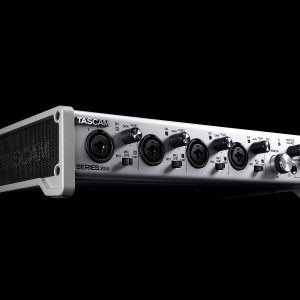

Continuing our legacy and passion for audio, the US-20×20 (twenty-by-twenty) “Celesonic” is the flagship of the Tascam line of interfaces. Designed for use in professional recording facilities or project studios, this audio interface supports 192 kHz and utilizes USB 3.0, a leading-edge transmission standard. With added features such as Mic Preamp Mode and Mixer Mode, it becomes a very versatile tool – along with being an interface for multi-channel recording.
Microphone preamplifiers are crucial for highest audio quality. The eight Tascam Ultra-HDDA mic preamps have an equivalent input noise (EIN) of –125 dBu. And 20 dB of headroom on the microphone and line inputs allow to easily handle high SPL transients from percussion and instruments.
Utilizing a high-performance Blackfin processor, the US-20×20 offers an advanced DSP mixer including EQ, compression and reverb effects on each channel. The processor not only excels on the dynamics and effects, but enables multi-channel transmission via USB 3.0 for the studio.
Additional significant features enable the seamless workflow of the professional engineer. Mode switching provides the options of using the US-20×20 as a standalone mic preamp, an audio interface, or as a mixer for sound reinforcement applications.
Complete connectivity to various types of audio equipment is achieved by utilizing the analogue inputs and outputs, digital input and output via coaxial and optical connectors, MIDI, and word clock BNC connectors.
The radical eye-catching style and angled industrial design of the US-20×20 make desktop recording a breeze. A rack-mount adapter is also included.
Read the review on Pro Tools Expert (11 Feb 2016)
Ultra-HDDA mic preamps provide pristine audio quality
Our original Ultra-HDDA mic preamps allow you to input high-quality audio from any audio source just by turning a knob. These are the same mic preamps that are in our HS-P82 professional recorders, which are popular in the broadcast and film industry. These versatile preamps can handle both condenser and dynamic mics, and will allow you to enjoy high-quality recording even if you are not an expert. These versatile preamps also feature line-level inputs for keyboards and other equipment.
Built-in Ultra-HDDA mic preamps have discrete construction that achieve –125 dBu EIN (Equivalent Input Noise)
Guitars can be directly connected enabling the use of 3rd-party plug-in effects
Wide dynamic range that can handle the sound pressures of drum recording easily
20 inputs and 20 outputs for versatility in many recording applications
With eight XLR/TRS inputs, two TRS inputs, multi-channel digital inputs via S/PDIF coaxial, and optical digital connectors, a total of 20 simultaneous inputs is possible when operating at 44.1 kHz or 48 kHz. As with the inputs, 20 simultaneous outputs is possible at 44.1 kHz or 48 kHz utilizing the ten TRS outputs, S/PDIF coaxial and optical digital outputs. The optical input/output support S/MUX2 and S/MUX4 – required for high sampling rates. Using two US-20×20 and the optical digital connections, it is possible to configure a 16-microphone recording system.
Note: When operating at 88.2 kHz or 96 kHz, up to 16 inputs and 16 outputs are possible. When operating at 176.4 kHz or 192 kHz, up to 12 inputs and 12 outputs are possible.
Eight XLR/TRS inputs with +48 V phantom power and two TRS inputs switchable between –10 dB and +4 dB
S/PDIF coaxial input/output enables connection with an external AD/DA converter
Word input/output enables connection with an external clock generator
Three switchable modes – Interface, Mic Preamp and Mixer
The versatile US-20×20 is an Interface for multitrack recording using a personal computer and DAW, a standalone mic preamp, or a mixer for live performances.
Mic preamp mode enabling use as a microphone preamplifier for analogue/digital output
Mixer mode enabling use for PA/SR and use as a keyboard mixer
Advanced DSP mixer paired with a new USB driver
An obstacle with computer-based recording is latency (delayed audio signals). New driver software has been developed to eliminate latency issues and driver setup problems. The built-in mixer utilizes the high-performance Dual Core BlackFin DSP making it possible to offer 4-band EQ and compression on each channel.
Note: When operating at 176.4 kHz or 192 kHz, the effects (EQ, compression, phase and reverb) of the DSP mixer cannot be used.
High-resolution recording at up to 192 kHz/24 bit
USB 3.0 computer connection, a leading-edge transmission standard
Advanced DSP mixer with 4-band equalizer and compressor on each channel
Reverb effect for monitoring enhances the performer’s motivation
Driver software can be installed without connecting the interface
USB 3.0 computer connection, a leading transmission standard
USB 3.0 is used in the US-20×20 for 24-channel transmission at 192 kHz/24-bit. This is not possible with USB 2.0.
Supported USB version
Operating system
USB 3.0 / USB 2.0
Windows 10
USB 2.0
Windows 8, Windows 7, OS X Yosemite (10.10), OS X Mavericks (10.9), OS X Mountain Lion (10.8)
Support for iOS devices and compatibility with many DAW applications
You will not need another audio interface if you decide you want to make music using an iPad or other iOS device. The performance of these interfaces has been tested with major DAWs – you can continue to use them even if you change DAW software. Since these units include MIDI inputs and outputs, they can also be used as MIDI interfaces.
Connect with an iPad or another iOS device
Tested with Sonar, Pro Tools, Cubase, Live, Studio One and GarageBand
MIDI input and output enable connection with keyboards and other MIDI devices
Rackmount adapters and hex keys are included
You can either utilize the brackets for rackmount installations or unscrew the brackets with the hex keys provided when using on a desktop.
Features at a glance
High-quality Ultra-HDDA (High Definition Discrete Architecture) microphone pre-amps with ultra-low noise (EIN: –125 dBu)
Recording at up to 192 kHz/24 bit
Support for Windows and Mac operating systems
USB 3.0 or USB 2.0 computer connection for 40-channel audio transmission at 44.1/48 kHz or 24-channel audio transmission at 176.4/192 kHz (USB3.0 requires Windows 10 or OS X 10.11.2 or later)
20 inputs/20 outputs available at 44.1/48 kHz/24 bit (10 analogue channels + 2 digital S/PDIF channels + 8 optical channels)
16 inputs/16 outputs available at 88.2/96 kHz/24 bit (10 analogue channels + 2 digital S/PDIF channels + 4 S/MUX optical channels)
12 inputs/12 outputs available at 176.4/192 kHz/24 bit (10 analogue channels + 2 digital S/PDIF channels)
Three selectable operation modes: audio interface, standalone micpreamp, digital mixer
DSP mixer with 4-band EQ and compression on each input channel (can be used in
Interface/Mixer mode)
Patch bay allows outputs to be assigned freely (can be used in Interface/Mixer mode)
DSP mixer settings can be stored in up to 10 scenes
USB Audio Compliance 2.0 for iPads and other iOS devices
Reverb effect can be added to the monitored audio
Low-latency monitoring via the DSP mixer
Inputs and outputs
Eight XLR/TRS combo jack analogue inputs with switchable phantom power (48 V)
Inputs 1 and 2 can be used for direct guitar input
Two TRS (balanced) inputs on rear panel
Input level range of 56 dB for using dynamic mics
Ten TRS (balanced) analogue outputs
TOS LINK optical digital multi-channel input and output (8 channels at 44.1/48 kHz, supporting S/MUX2 and S/MUX4)
S/PDIF coaxial digital input and output
BNC word clock input and output
Two standard TRS headphones outputs with 2 x 70 mW output power
Separate controls for line and headphones output levels
MIDI input/output
Other features
DAW compatibility (ProTools, Cubase, Live, Studio One, Garage Band)
Rack-mount adapter included
Dedicated AC adapter included
Angled industrial design provides excellent usability on a desktop
New features with firmware version 2.0
Simultaneous playback of ASIO and WDM is now possible by selecting an alternative driver.
Notification function keeps you updated with the latest information for your product
Automatic update notification helps you to keep your software and firmware up to date (you can install new updates with the press of a button)
New features with firmware version 2.1
The internal mixer can be bypassed for situations when using an external microphone preamp
Select whether to allow the signal to be sent from PC to the stereo bus
In Mic Preamp mode, the US-20×20 can now be used as a D/A converter
The clock source can be selected without the settings panel when using the US-20×20 standalone
New features with USB driver version 4.0
With a powerful computer, ultra-short latency times can now be achieved by selecting a buffer size up from four samples
Optimised display of the software window according to the screen resolution
Further improved overall stability
Supported Operating Systems
Windows
Windows 10 (November 2019 Update 1909)
Windows 10 (May 2019 Update 1903)
Windows 8.1
Windows 8
Windows 7
Mac
macOS Catalina (10.15)
macOS Mojave (10.14)
macOS High Sierra (10.13)
macOS Sierra (10.12)
OS X El Capitan (10.11)
OS X Yosemite (10.10)
OS X Mavericks (10.9)
OS X Mountain Lion (10.8)
iOS
iOS 13 / iPadOS
iOS 12
iOS 11
iOS 10
iOS 8
Specifications
General
Sampling frequencies
USB 3.0: 44.1/48/88.2/96/176.4/192 kHzUSB 2.0: 44.1/48/88.2/96 kHz
Quantization bit depth
16/24-bit
Analogue inputs
Mic inputs (balanced, IN1–IN8)
XLR-3-31 equivalent (1: GND, 2: HOT, 3: COLD)
Input impedance
2.4 kΩ
Nominal input level (gain knob at MAX)
−68 dBu (0.0003 Vrms)
Nominal input level (gain knob at MIN)
−12 dBu (0.195 Vrms)
Maximum input level
+8 dBu (1.947 Vrms)
Gain range
56 dB
Instrument inputs (unbalanced, IN1–IN2)
6.3mm (1/4″) standard TS jacks (Tip: HOT, Sleeve: GND)
Input impedance
1 MΩ or more
Nominal input level (gain knob at MAX)
−68 dBV (0.0004 Vrms)
Nominal input level (gain knob at MIN)
−12 dBV (0.251 Vrms)
Maximum input level
+8 dBV (2.512 Vrms)
Gain range
56 dB
Line inputs (balanced, IN1–IN8)
6.3mm (1/4″) standard TRS jacks (Tip: HOT, Ring: COLD, Sleeve: GND)
Input impedance
10 kΩ
Nominal input level (gain knob at MAX)
−52 dBu (0.0019 Vrms)
Nominal input level (gain knob at MIN)
+4 dBu (1.228 Vrms)
Maximum input level
+24 dBu (12.282 Vrms)
Gain range
56 dB
Line inputs (unbalanced, LINE IN 9–10, LEVEL switch set to −10dBV)
6.3mm (1/4″) standard TS jacks (Tip: HOT, Sleeve: GND)
Input impedance
10 kΩ
Nominal input level
−10 dBV (0.3162 Vrms)
Maximum input level
+10 dBV (3.162 Vrms)
Line inputs (balanced, LINE IN 9–10, LEVEL switch set to +4dBu)
6.3mm (1/4″) standard TRS jacks (Tip: HOT, Ring: COLD, Sleeve: GND)
Input impedance
10 kΩ
Nominal input level
+4 dBu (1.228 Vrms)
Maximum input level
+24 dBu (12.282 Vrms)
Analogue outputs
Line outputs (balanced, LINE OUT 1–10)
6.3mm (1/4″) standard TRS jacks (Tip: HOT, Ring: COLD, Sleeve: GND)
Output impedance
100 Ω
Nominal output level
+4 dBu (1.228 Vrms)
Maximum output level
+24 dBu (12.277 Vrms)
Headphones outputs (PHONES 1/2)
6.3mm (1/4″) standard stereo jacks
Maximum output power
70mW + 70mW (THD+N 0.1% or less, into 32 Ω load)
Frequency response (Input to PHONES 1/2 output)
At 44.1 kHz and 48 kHz
20 Hz – 20 kHz, ±1.0 dB (JEITA)
At 88.2 kHz and 96 kHz
20 Hz – 40 kHz, ±2.0 dB (JEITA)
At 176.4 kHz and 192 kHz
20 Hz – 80 kHz, ±5.0 dB (JEITA)
Digital audio inputs and outputs
COAXIAL IN
RCA pin jacks
Signal format
IEC 60958-3 (S/PDIF)
Input impedance
75 Ω
Input level
0.5 Vpp/75 Ω
COAXIAL OUT
RCA pin jacks
Signal formats
IEC 60958-3 (S/PDIF) or IEC 60958-4 (AES/EBU), selectable on the Settings Panel
Output impedance
75 Ω
Output level
0.5 Vpp/75 Ω
OPTICAL (S/MUX) IN/OUT
OPTICAL (JEITA RC-5720C)
Signal format
Multi-channel optical format (supports S/MUX at 88.2 kHz, 96 kHz, 176.4 kHz or 192 kHz)
Other inputs and outputs
USB
USB 3.0 B type
Transfer rate
USB 3.0 Super Speed (5 GBit/s)
MIDI IN
5-pin DIN
Format
standard MIDI
MIDI OUT
5-pin DIN
Format
standard MIDI
WORD IN
BNC (Termination on/off switch included)
Input voltage
2.0Vpp – 5.0Vpp
Input impedance
75 Ω ±10 %
Permitted frequency deviation during external synchronization
±100 ppm
WORD OUT
BNC (OUT/THRU switch included)
Output voltage
2.0 Vpp (into 75Ω load)
Output impedance
75 Ω ±10 %
Sampling frequencies
44.1 kHz, 48 kHz, 88.2 kHz, 96 kHz, 176.4 kHz, 192 kHz
Audio performance
Mic amp EIN (equivalent input noise)
−125 dBu or lower
Frequency response (Input to LINE OUT (BALANCED))
At 44.1/48 kHz
20 Hz – 20 kHz, ±0.5 dB (JEITA)
At 88.2/96 kHz
20 Hz – 40 kHz, ±0.5 dB (JEITA)
At 176.4/192 kHz
20 Hz – 80 kHz, ± 5 dB (JEITA)
S/N ratio
104 dB or higher (MIC/LINE IN to LINE OUT, gain knob at MIN, JEITA)
Distortion
0.004 % or less (MIC/LINE IN to LINE OUT, 1 kHz sine wave, at nominal input level and maximum output level)
Crosstalk
100 dB or more (MIC/LINE IN to LINE OUT, 1 kHz)
Computer system requirements
Important note: Operation of this unit was confirmed using standard computers that meet the above requirements. This does not guarantee operation with all computers that meet the above requirements. Even computers that meet the same system requirements might have processing capabilities that differ according to their settings and other operating conditions
Windows
Computer hardware requirements
Windows computer with a USB 3.0 or USB 2.0 port
CPU/processor speed
2 GHz or faster dual core processor (x86)
Memory
2 GB or more
Screen resolution
1280×800 pixels or more
Mac OS X
Supported operating system, USB 3.0
OS X El Capitan (10.11.2 or later)
Computer hardware requirements
Mac with a USB 3.0 or USB 2.0 port
CPU/processor speed
2 GHz or faster dual core processor
Memory
2 GB or more
Screen resolution
1280×800 pixels or more
Supported audio drivers
Windows: USB Audio Class 2.0, ASIO 2.0, WDM (MME), MIDIMac: Core Audio, Core MIDI
Power supply and other specifications
Power supply
DC12V AC adapter (GPE248-120200-Z)
Power consumption
20 W
Dimensions (W × H × D)
445 mm × 59 mm × 222 mm (with standard frame attached)483 mm × 44 mm × 222 mm (with rack mount adapters attached)
Weight
2.7 kg
Permissible operating temperature range
5–35 °C

Reviews
There are no reviews yet.